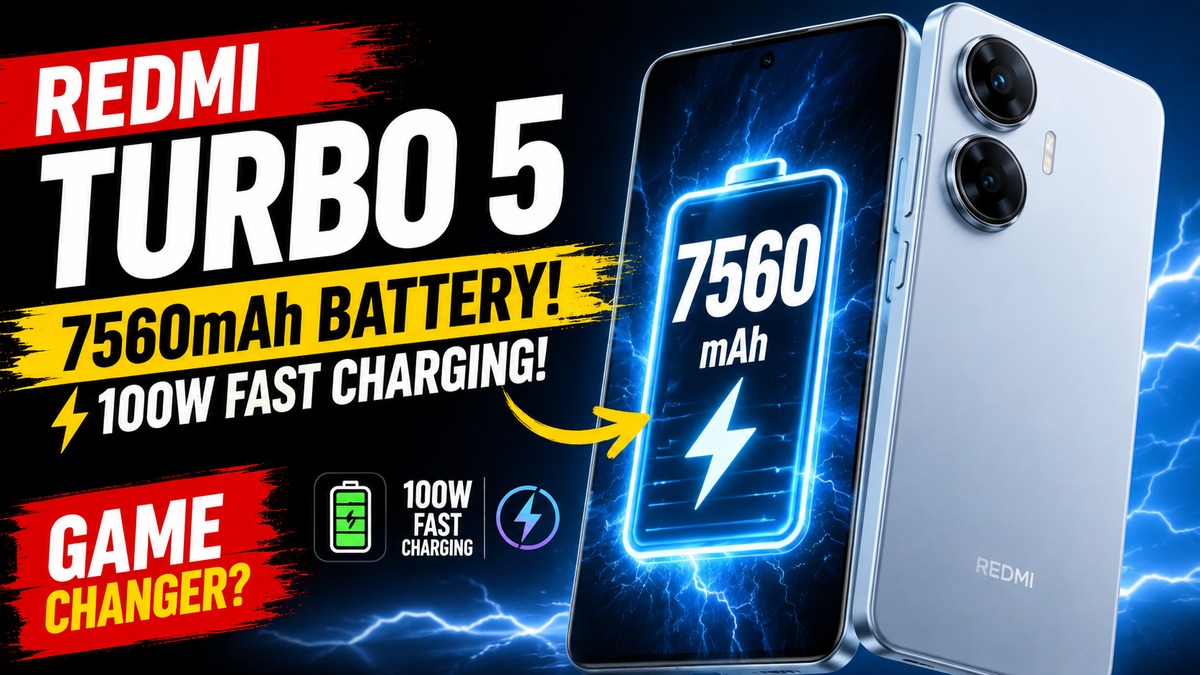
Redmi Turbo 5 is shaping up as a battery-first performance phone, with reports pointing to a 7,560mAh battery, 100W wired fast charging and a MediaTek Dimensity 8500 Ultra chipset. If the India model keeps the same formula, it could reset what buyers expect from mid-premium Android phones.
A Battery Story That Is Bigger Than One Phone
The Redmi Turbo 5 is not interesting only because it is another fast Android phone. It is interesting because it points to a bigger shift in smartphone priorities. For years, brands chased thinner bodies, brighter displays and faster processors while battery capacity moved slowly. Now, silicon-carbon battery technology and more efficient chipsets are allowing brands to put much larger cells into phones without turning them into bricks.
The headline figure around the Redmi Turbo 5 is a 7,560mAh battery paired with 100W wired fast charging. That combination is the reason this phone has started to attract attention. A battery this large was once associated with rugged phones or bulky niche devices. Redmi is trying to bring that endurance into a mainstream performance phone format.
What The Redmi Turbo 5 Is Expected To Offer
Reports around the Redmi Turbo 5 point to a 6.59-inch AMOLED display with 1.5K resolution and a 120Hz refresh rate. The phone is expected to use MediaTek's Dimensity 8500 Ultra chipset, paired with fast LPDDR5X memory and UFS 4.1 storage on higher variants. Camera expectations include a 50MP primary rear camera, an 8MP ultra-wide camera and a 20MP selfie camera.
The biggest talking point, however, is the battery. The Chinese model has been reported with a 7,560mAh cell, 100W wired charging and 27W wired reverse charging. Some reports also mention high dust and water resistance ratings, including IP66, IP68, IP69 and IP69K, which would strengthen the phone's durability pitch.
For India, leaks have suggested that the device could arrive with specifications close to the China model. Xiaomi India teasers and retail microsite activity have already increased expectations around an India launch, though final pricing and variant details still need official confirmation.
Why 7,560mAh Changes The Conversation
A 7,560mAh battery is not just a bigger number on a spec sheet. It changes how buyers think about daily use. Heavy users often choose phones based on whether they can survive navigation, gaming, hotspot use, camera recording and social media without needing a top-up before evening. A battery this large gives Redmi a simple message: this phone is built for people who punish their devices.
The more important point is psychological. A 5,000mAh battery has become normal in Android phones. A 6,000mAh battery is now common in endurance-focused models. A mainstream performance phone moving beyond 7,500mAh pushes the benchmark higher. Once buyers see that kind of capacity in a slim-enough, fast-enough phone, rivals will be forced to respond.
100W Charging Keeps The Big Battery Practical
Large batteries create one obvious problem: charging time. Redmi's answer is 100W wired fast charging. That matters because a massive battery only feels convenient if it can be refilled quickly. Without fast charging, a 7,560mAh phone could become frustrating for users who forget to charge overnight.
The combination of high capacity and high charging speed is what makes the Turbo 5 more compelling than a simple endurance phone. It aims to offer both long runtime and short downtime. For gamers, commuters and content-heavy users, that balance is more valuable than chasing one metric alone.
Performance Phone, Not Just Battery Phone
The Turbo branding usually targets users who care about speed. That is why the expected Dimensity 8500 Ultra chipset is important. If the phone delivers strong thermal control, smooth gaming and efficient power management, the battery advantage becomes even more meaningful.
A large battery paired with a weak processor is easy to dismiss. A large battery paired with a serious performance chip becomes a different product. It can appeal to gamers, students, travellers, delivery professionals, creators and anyone who wants a phone that does not constantly need a charger nearby.
Buyer Impact
For buyers, the Redmi Turbo 5 could be a strong option if three things line up: the India model keeps the large battery, pricing stays aggressive, and Xiaomi delivers reliable software support. Battery size alone will not guarantee success, but it gives the phone a clear identity in a crowded market.
Buyers should still wait for official India specifications before making a decision. Imported China-model details do not always transfer perfectly to Indian variants. Network band support, charger inclusion, software version, camera tuning and final battery capacity can vary between regions.
If the reported specs hold, the Turbo 5 could become especially attractive for users who want a phone for gaming, travel, long workdays and heavy entertainment use without jumping into ultra-premium pricing.
Market Impact
Redmi's biggest strength has always been value pressure. When Redmi pushes a major spec aggressively, other brands often have to react. A 7,560mAh battery with 100W charging could put pressure on Realme, iQOO, OnePlus, Motorola and POCO-style performance phones in the same segment.
The battery race is also becoming more visible because many buyers are keeping phones longer. A phone that starts with more battery headroom may feel useful for more years, even after natural battery degradation. That makes large-capacity phones easier to market as practical long-term purchases.
What Still Needs Confirmation
The biggest open questions are price, India launch timing, variant availability and whether the India version keeps the exact 7,560mAh battery. Camera performance also needs real-world testing. Redmi performance phones can be strong on speed and value, but buyers who care about photography will want to see image quality before judging the full package.
There is also the software question. HyperOS has improved Xiaomi's ecosystem story, but buyers will care about update timelines, pre-installed apps and long-term stability. A huge battery may bring people in; good software will decide whether they stay satisfied.
Future Outlook
If Redmi launches the Turbo 5 with the expected battery and charging setup, it could become one of the clearest examples of the next smartphone trend: endurance without sacrificing performance. The industry has already moved from 4,500mAh to 5,000mAh as a baseline. The next fight may be around 7,000mAh-plus phones that still feel mainstream.
That is why the Redmi Turbo 5 matters. It may not be the only phone with a big battery, but it could help normalize the idea that a performance phone should last far longer than today's typical flagship.
Conclusion
Redmi Turbo 5 could rewrite battery expectations because it combines three things buyers understand instantly: a huge 7,560mAh battery, 100W fast charging and performance-grade hardware. If Xiaomi brings that mix to India at the right price, rivals will have a serious endurance benchmark to chase.
The final verdict must wait for official India specifications and real-world testing. But the direction is already clear: battery life is becoming a headline feature again, and Redmi wants the Turbo 5 to be one of the phones that makes buyers demand more.
FAQ
What is the expected battery capacity of the Redmi Turbo 5?
The Redmi Turbo 5 is widely reported to feature a 7,560mAh battery, though India-specific details should be treated as unofficial until Xiaomi confirms them.
How fast is the Redmi Turbo 5 expected to charge?
Reports point to 100W wired fast charging, with some sources also mentioning wired reverse charging support.
Which processor could power the Redmi Turbo 5?
The phone is expected to use the MediaTek Dimensity 8500 Ultra chipset.
Why is the Redmi Turbo 5 important?
It could raise expectations for battery capacity in mainstream performance phones, especially if it launches with aggressive pricing.