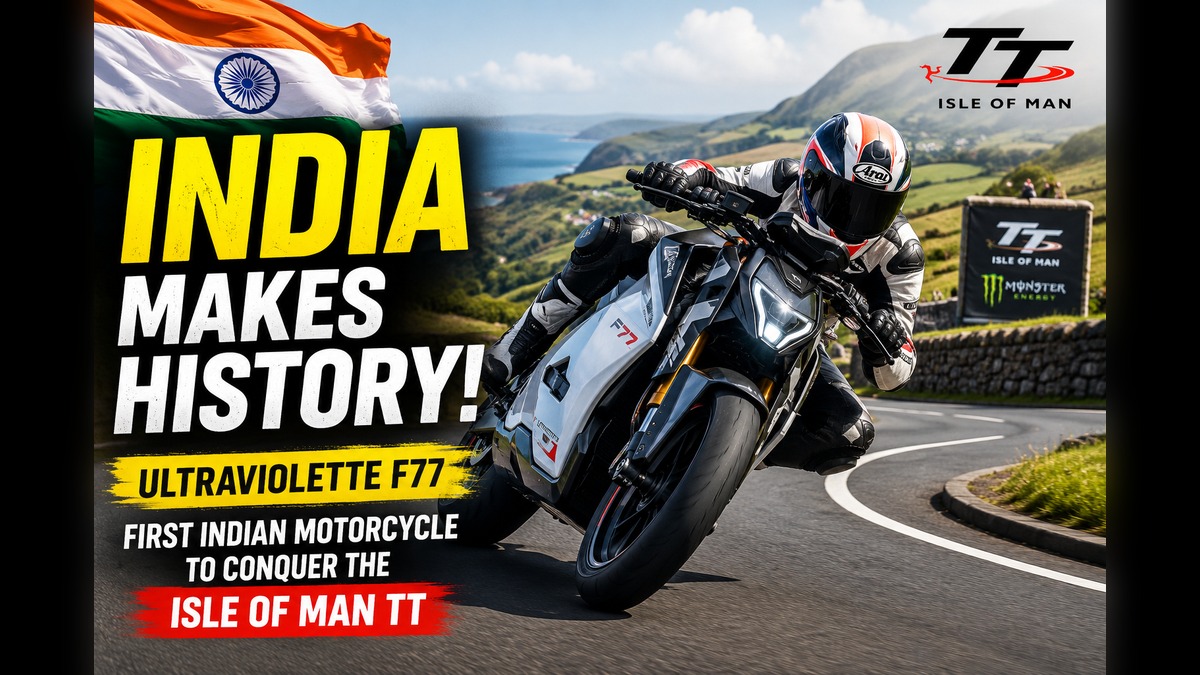
The Ultraviolette F77 Mach 2 has become the first Indian production motorcycle to complete a lap of the Isle of Man TT Mountain Course. The achievement is more than a record-book moment: it gives India's performance EV industry a serious global proof point.
India's Electric Motorcycle Moment Arrives On The World's Toughest Stage
For years, Indian motorcycle makers have been judged mainly by value, efficiency and domestic scale. Ultraviolette has just pushed that conversation into a very different arena. The Bengaluru-based electric motorcycle company has taken the F77 Mach 2 to the Isle of Man TT Mountain Course and completed a lap of one of the most demanding motorcycle circuits in the world.
That matters because the Isle of Man TT is not a marketing parade. The Mountain Course runs for roughly 37.72 miles, or 60.72 km, across public roads, fast sections, elevation changes, villages, blind crests and unforgiving corners. It is a place where performance claims are quickly separated from real engineering depth.
The F77 Mach 2's completion of the course makes it the first Indian production motorcycle to achieve this milestone. For a young electric motorcycle brand from India, that is a statement far bigger than a lap time headline.
What Exactly Happened
On June 6, 2026, five Ultraviolette F77 Mach 2 motorcycles completed a lap of the Isle of Man TT Mountain Course. The ride involved former Isle of Man TT winner James Hillier, actor and motorcycle enthusiast Rannvijay Singha, and multiple national racing champion Abhishek Vasudev.
The achievement has been reported as being recognised by the Asia Book of Records and the India Book of Records. That gives the milestone a formal record dimension, but the real significance lies in where it happened and what it says about the motorcycle.
Electric two-wheelers in India are often associated with scooters, urban commuting and cost saving. The F77 sits in a very different space. It is designed as a performance electric motorcycle, and the Isle of Man run gives Ultraviolette a global stage on which to argue that Indian EV engineering can be fast, durable and aspirational.
Why The Isle Of Man TT Course Matters
The Isle of Man TT Mountain Course is one of motorcycling's most respected proving grounds. Its reputation comes from the sheer complexity of the roads: high-speed sections, narrow lanes, surface changes, heavy braking zones and constant rhythm changes. Unlike a closed modern circuit with wide run-off areas, the TT course is a public-road challenge with very little margin for error.
Completing a lap there is not the same as riding around a normal race track. It tests sustained power delivery, braking confidence, cooling, stability, tyre management, rider trust and reliability. For an electric motorcycle, it also adds questions around energy management and thermal consistency over a long, fast course.
That is why this achievement carries weight. Ultraviolette did not merely take the F77 to an overseas event. It put the motorcycle on a route that is globally understood as a serious test of machine and rider.
Why It Matters For Indian Buyers
For buyers in India, this does not automatically mean the F77 is the right motorcycle for everyone. It remains a performance-focused electric motorcycle with a specific audience. But the achievement does change how the product is perceived.
Until now, many electric motorcycle discussions in India have revolved around range anxiety, price, charging and long-term reliability. Those questions still matter. But a successful Isle of Man TT Mountain Course lap gives the F77 a new kind of credibility: the ability to perform outside carefully controlled domestic conditions.
Potential buyers may see this as evidence that Ultraviolette is not building a novelty EV. The company is trying to build a motorcycle that can stand beside serious performance machines, even if its powertrain is completely different from a petrol engine.
The Bigger Market Impact
The Indian electric two-wheeler market has been dominated by scooters because scooters solve a clear mass-market problem: daily commuting. Motorcycles are harder. Riders expect emotion, acceleration, styling, stability and long-distance confidence. A commuter EV can win with practicality; a performance motorcycle must win hearts as well as spreadsheets.
Ultraviolette's Isle of Man move is therefore a branding and engineering play at the same time. It tells investors, customers and rivals that India can produce an electric motorcycle with global ambition. That is important at a time when Indian EV makers are trying to move beyond domestic subsidy cycles and into export-led credibility.
If Ultraviolette can convert this moment into stronger global distribution, better owner confidence and continued product development, the F77 could become a reference point for India's premium EV manufacturing push.
Competitor Impact
For legacy motorcycle makers, the message is simple: Indian EV startups are no longer only chasing city commuters. They are moving into performance storytelling, motorsport-adjacent credibility and international brand building.
That could pressure traditional manufacturers to accelerate their own electric motorcycle strategies. It also gives Indian buyers a reason to take homegrown performance EVs more seriously. Until now, premium motorcycling in India has often meant imported brands or petrol-powered machines from established global players. Ultraviolette wants to challenge that assumption.
The F77's achievement will also be watched by other EV startups. A global proof point can raise expectations across the segment. Once one Indian electric motorcycle brand shows ambition at this level, others will be judged more sharply on whether they are merely assembling products or building engineering-led machines.
What Still Needs To Be Proven
This milestone is meaningful, but it does not answer every question. Buyers will still care about real-world range, charging convenience, service reach, parts availability, software stability and resale value. A record lap creates excitement; ownership experience creates long-term trust.
The F77 also needs to sustain its reputation beyond one headline moment. International exposure is useful only if it is followed by consistent product support, transparent communication and a growing service ecosystem.
In other words, the Isle of Man achievement is a powerful beginning, not the final verdict. It gives Ultraviolette a story few Indian motorcycle brands can tell. Now the company has to turn that story into sales, loyalty and wider global acceptance.
Future Outlook
India's EV industry needs more moments like this. Not every breakthrough has to be about lowest price or highest range. Sometimes a brand has to prove that it can build something desirable, brave and technically convincing.
The F77's Isle of Man lap does exactly that. It gives Indian electric mobility a performance image at a time when global markets are still deciding which new EV brands deserve attention. If Ultraviolette continues to invest in product quality and international expansion, this could become one of the defining moments in India's electric motorcycle story.
Conclusion
The Ultraviolette F77 Mach 2 has achieved something no Indian production motorcycle had done before: completing a lap of the Isle of Man TT Mountain Course. The record is important, but the symbolism is even bigger.
It shows that Indian electric motorcycle engineering is no longer limited to domestic commuting conversations. It can enter one of motorcycling's most iconic arenas and come away with a credible global milestone. For Ultraviolette, this is a brand-defining moment. For India's EV industry, it is a signal that the next chapter may be faster, bolder and far more international.
FAQ
What did the Ultraviolette F77 achieve?
The Ultraviolette F77 Mach 2 became the first Indian production motorcycle to complete a lap of the Isle of Man TT Mountain Course.
How long is the Isle of Man TT Mountain Course?
The course is about 37.72 miles, or roughly 60.72 km, and is considered one of the world's most demanding motorcycle routes.
Who rode the F77 motorcycles?
The ride involved James Hillier, Rannvijay Singha and Abhishek Vasudev, with five F77 motorcycles completing the course.
Why is this important for India?
It gives Indian electric motorcycle engineering a rare global performance milestone and strengthens the credibility of India's premium EV ambitions.