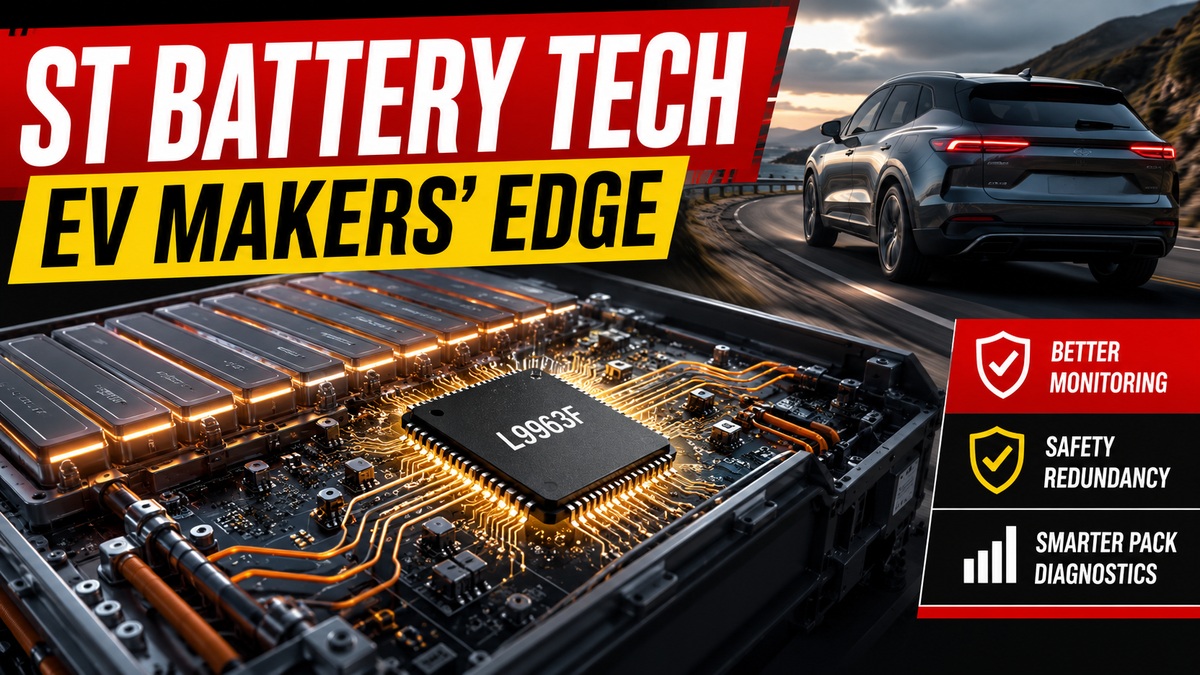
STMicroelectronics' latest L9963F battery-management IC is not a headline-grabbing battery chemistry breakthrough, but it could still matter deeply to electric-vehicle makers. By improving monitoring accuracy, safety redundancy, synchronization and upgrade compatibility, the chip targets one of the least glamorous but most important parts of the EV race: the intelligence that keeps a battery pack safe, predictable and usable over time.
Why This Battery Tech Matters
The next big advantage in electric vehicles will not come only from larger batteries, faster chargers or more powerful motors. Increasingly, it will come from how precisely a vehicle can understand the battery it already has. That is where battery-management systems, often shortened to BMS, become strategically important.
A BMS is the electronic nervous system of an EV battery pack. It watches cell voltage, current, temperature, state of charge, state of health, balancing behaviour and fault conditions. If the system is conservative, drivers may see less usable range than the battery could safely deliver. If it is inaccurate, the vehicle can misjudge range, charging limits or thermal risk. If it is not robust enough, a battery fault can become expensive, dangerous or difficult to diagnose.
STMicroelectronics' new L9963F automotive battery-management IC enters that conversation at an important moment. EV makers are under pressure to reduce cost, improve safety, protect warranties and deliver more confidence to customers who still worry about range and long-term battery life. The L9963F is designed for lithium battery packs in hybrid and full-electric vehicles, industrial energy-storage systems and 48V or 96V architectures. On paper, that may sound like a supplier-side component announcement. In practice, it touches several problems automakers care about every day.
What ST Has Introduced
The L9963F is an enhanced version of ST's established L9963E battery-management platform. The important detail is compatibility. ST positions the new device as a fully compatible replacement for the earlier chip, allowing existing users of the L9963 family to move to the upgraded part without major hardware or software redesigns.
That matters because automotive electronics are not upgraded casually. Any component inside a high-voltage battery system must pass demanding validation, safety, durability and supplier-readiness checks. A drop-in improvement can be far more attractive than a clean-sheet redesign, especially for automakers and Tier-1 suppliers already building pack architectures around an existing chip family.
One L9963F device can monitor four to fourteen stacked battery cells. Multiple devices can be connected for much larger battery arrays, with support described for chains reaching up to 31 devices and 434 series-connected cells. That makes the device relevant beyond small auxiliary packs and into large EV and energy-storage applications where accurate, synchronized monitoring across many cells is essential.
The Real Advantage: Better Battery Visibility
The headline benefit is not that the chip magically increases battery capacity. It does not. The advantage is that better measurement can let automakers manage existing capacity with greater confidence.
The L9963F includes a 16-bit analog-to-digital converter and high-accuracy voltage measurement across the cell-voltage range. It also supports synchronized current and voltage sampling. In simple terms, the system is designed to take a cleaner snapshot of what is happening inside the battery pack at a given moment.
That can help with state-of-charge estimation, balancing decisions and fault detection. In the real world, a driver experiences those functions as more trustworthy range estimates, smoother charging behaviour and fewer unexplained battery warnings. For the manufacturer, better visibility can support more refined control strategies, more precise diagnostics and potentially lower warranty exposure.
This is why semiconductor progress matters in EVs. The vehicle's battery chemistry may get the spotlight, but the measurement layer determines how boldly the software can use that chemistry.
Safety Is The Bigger Story
Safety improvements are central to the L9963F story. The device adds a fully redundant cell-measurement path with ADC swap capability, a feature intended to support functional safety and limp-home behaviour when part of the monitoring path develops a fault.
That redundancy is important because EV battery packs contain many individual cells operating as a tightly managed system. When monitoring electronics lose confidence in a cell reading, the vehicle must respond carefully. A false alarm can inconvenience the owner. A missed fault can become serious. Redundant measurement gives the system a second way to verify what it is seeing.
The chip also includes coulomb counting for current monitoring and overcurrent detection, including when ignition is on or off. That matters because battery packs are not relevant only while the vehicle is being driven. They can experience load, leakage, service activity, standby drain and charging-related conditions while parked. Better monitoring during those states can help detect problems earlier.
Why A Drop-In Upgrade Could Speed Adoption
Automakers move slowly when a change affects safety-critical electronics. That is why the compatible-replacement angle may be just as important as the technical specification sheet.
If a supplier can offer better monitoring, redundancy and synchronization without forcing a complete redesign, the path to adoption becomes easier. Existing board layouts, software assumptions and pack-control strategies may need less disruption. For a production program, that can reduce engineering risk and shorten the upgrade discussion.
This does not mean every EV using the earlier platform will immediately receive the new device. Customer programs have not been publicly confirmed, and automakers rarely disclose every semiconductor change inside a battery pack. But the upgrade path is strategically useful because it gives pack designers a way to improve capability while preserving architecture continuity.
What EV Makers Could Gain
The practical advantage for EV makers falls into four areas: safety, efficiency, diagnostics and customer confidence.
First, improved measurement and redundancy can support safer pack operation. Second, more accurate cell monitoring can help battery software make better decisions about balancing and usable energy. Third, better fault detection can improve service diagnostics, helping technicians identify battery issues faster. Fourth, more reliable state-of-charge estimation can reduce the gap between predicted range and real driving experience.
None of these points should be confused with a direct claim that the L9963F increases vehicle range by a fixed number. No public data supports that. The more realistic claim is subtler: better battery intelligence can help EV makers use battery packs more confidently and manage risk more precisely.
Buyer Impact: What Drivers May Notice
Most car buyers will never ask which battery-management IC sits inside their EV. They should not have to. But they may notice the outcomes that better battery management can support.
A well-managed battery pack can deliver more consistent range estimation, more stable long-term performance and fewer unpleasant surprises during ownership. It can also help protect the battery from damaging operating conditions. Over time, that can matter for resale value, warranty costs and owner confidence.
For Indian EV buyers, this is especially relevant. Heat, traffic, mixed charging quality, long-distance uncertainty and high battery-replacement anxiety all shape purchase decisions. Better pack monitoring will not solve every EV concern, but it is one of the foundations required to make EVs feel dependable in demanding conditions.
Market Impact
The wider market context is clear: battery-management electronics are becoming more valuable as EV adoption grows. Automakers need packs that are cheaper, safer, easier to diagnose and more predictable over many years of use. Semiconductor suppliers that can improve the control layer are therefore gaining importance in the EV supply chain.
Battery cost remains the largest single pressure point in electric vehicles. If better monitoring helps automakers reduce buffer margins, improve cell balancing, detect faults earlier or avoid unnecessary warranty replacements, the financial impact can be meaningful even without a dramatic chemistry breakthrough.
This is also why BMS technology is relevant to energy storage. Large stationary battery systems face many of the same issues as EVs: cell-level visibility, safety, balancing, fault detection and lifetime management. A chip family that scales from smaller voltage systems to large series-connected arrays can serve multiple growth markets.
Competitor Pressure
ST is not alone in this race. Infineon, Texas Instruments, NXP, Renesas and other semiconductor companies all compete for roles in EV battery electronics. The competition is not just about one headline specification. It is about accuracy, safety certification strategy, software ecosystem, supply reliability, cost, integration and how easily an automaker can adopt the solution.
The L9963F raises the bar in a practical way. It signals that BMS suppliers are improving established platforms rather than waiting for the next complete generation. That can pressure rivals to offer similar upgrade paths for customers that want safer and smarter packs without disrupting production programs.
Missing Details
Several important details remain unconfirmed. ST has not announced specific automaker customers for this new chip. There is no public adoption timeline for production EVs. There are no verified claims of additional driving range, faster charging, lower vehicle prices or direct battery-cost reduction.
That restraint is important. Battery-management technology can enable better decisions, but the final benefit depends on pack design, cell chemistry, thermal management, software calibration and the automaker's safety strategy. A strong chip is only one part of a larger system.
The Bottom Line
ST's new battery-management IC is not the kind of battery news that creates instant showroom excitement. It is more important than that. It belongs to the hidden engineering layer that determines how safe, reliable and confidence-inspiring an EV feels after thousands of kilometres and years of charging cycles.
For EV makers, the advantage is not a single dramatic number. It is the possibility of safer monitoring, better diagnostics, more accurate pack data and easier upgrades from an established platform. In a market where battery confidence can decide whether buyers switch to electric, that kind of behind-the-scenes progress can become a serious competitive edge.
FAQ
What is ST's new battery technology?
It is the L9963F automotive battery-management IC, designed to monitor and help manage lithium battery packs in EVs, hybrids, energy-storage systems and 48V or 96V applications.
Will it directly increase EV range?
No confirmed range increase has been published. Its value is in better monitoring, safety redundancy, synchronization and diagnostics, which can help automakers manage battery packs more effectively.
Why does battery management matter in an EV?
The battery-management system tracks cell voltage, current, temperature, state of charge, health and fault conditions. It helps protect the pack and supports reliable range estimation.
Which companies compete with ST in this area?
Major competitors in automotive battery-management electronics include Infineon, Texas Instruments, NXP and Renesas, among others.