India's first retail E85 fuel station has transformed a long-discussed policy objective into a consumer-facing reality. While the rollout currently remains limited, it opens the door to a new chapter in alternative fuels, raising important questions about fuel costs, vehicle compatibility, infrastructure investments and the future balance between petrol, CNG, hybrids and electric vehicles.
Introduction
For years, India's fuel strategy has been dominated by one major objective: reducing dependence on imported crude oil while creating a stronger domestic energy ecosystem. Ethanol blending became one of the key tools to achieve that objective, leading to the rapid adoption of E10 and later E20 fuel programs. Now, the opening of the country's first retail E85 fuel station marks another significant milestone in that journey.
At first glance, the development may appear symbolic. One fuel station alone will not transform the market. Yet its significance extends far beyond a single retail location. It represents the first practical consumer-facing test of a fuel that has long been discussed by policymakers, fuel companies and automakers.
The bigger question is whether E85 can evolve from a niche experiment into a viable mainstream alternative capable of influencing vehicle purchasing decisions. If it succeeds, it could alter ownership economics, reshape automaker product plans and create a new competitive dynamic involving petrol vehicles, hybrids, CNG models and electric cars.
What Happened
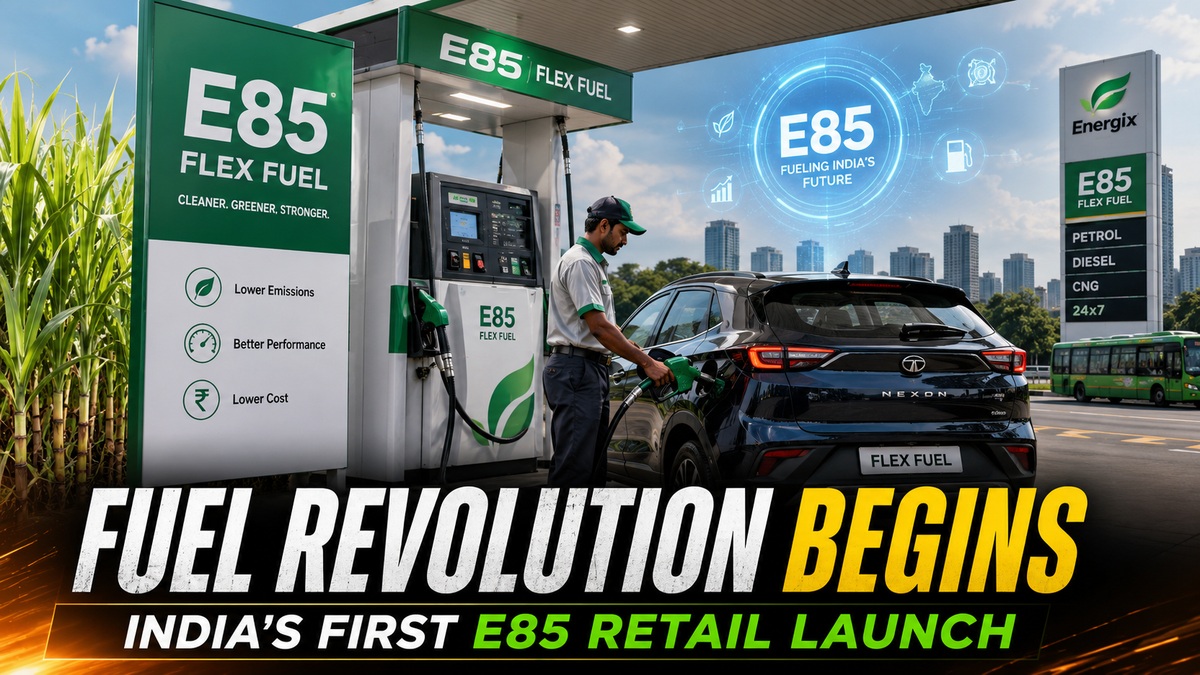
Delhi has become home to India's first retail E85 fuel station, making higher-ethanol fuel available directly to consumers. E85 contains up to 85 percent ethanol and significantly less petrol than conventional fuel blends currently sold across the country.
The launch arrives at a time when India continues to expand ethanol blending targets as part of a broader strategy aimed at lowering crude oil imports, improving energy security and supporting domestic agricultural supply chains.
The move also aligns with ongoing industry efforts to develop flex-fuel capable vehicles. Unlike conventional petrol-powered vehicles, flex-fuel models are engineered to operate on varying ethanol concentrations, including much higher blends such as E85.
While the initial rollout remains limited, the symbolic importance is substantial. Fuel infrastructure often acts as the foundation upon which future vehicle ecosystems are built. Without fuel availability, automakers have little incentive to launch compatible products. Conversely, without compatible vehicles, fuel stations have little reason to invest in specialized infrastructure.
The launch therefore serves as an important starting point for solving the classic chicken-and-egg problem that has historically slowed alternative fuel adoption around the world.
Missing Details
Despite the significance of the announcement, several important details remain unclear.
First, there is limited visibility regarding nationwide rollout timelines. A single station proves technical feasibility but does not reveal how quickly a larger retail network can be established.
Second, long-term pricing remains uncertain. Consumer interest in E85 will largely depend on meaningful cost advantages versus petrol. Ethanol-based fuels generally contain less energy per litre than petrol, meaning vehicles often experience lower fuel efficiency. The crucial ownership calculation therefore depends not only on pump prices but also on actual real-world mileage.
Third, the list of compatible vehicles remains extremely small. While manufacturers have discussed flex-fuel programs, consumers currently have limited choices in showrooms.
Fourth, supply chain stability remains a major question. Sustained E85 adoption would require consistent ethanol production volumes, transportation infrastructure and quality control mechanisms. A small pilot rollout can function with limited supply, but large-scale adoption presents entirely different logistical challenges.
Finally, resale value implications remain unknown. Buyers often consider future market demand before purchasing new technology vehicles. Until a broader ecosystem develops, predicting residual values for flex-fuel models remains difficult.
Contradictions and Unanswered Questions
The emerging E85 discussion contains several apparent contradictions.
Supporters highlight potentially lower operating costs due to reduced fuel prices. Critics point out that lower energy density can reduce fuel economy, potentially offsetting some of those savings. The final ownership equation depends heavily on future pricing structures.
Another contradiction involves environmental positioning. Ethanol is often promoted as a cleaner alternative to conventional fossil fuels because it originates from renewable feedstocks. However, critics continue to debate lifecycle emissions, land usage, water consumption and agricultural resource allocation.
There is also a strategic contradiction facing automakers. Many manufacturers are simultaneously investing in electric vehicles, hybrids, compressed natural gas technologies and flex-fuel development. Determining where future consumer demand ultimately settles remains uncertain.
A final unresolved issue concerns consumer awareness. The technical distinction between E20-compatible vehicles and true flex-fuel vehicles is not always clearly understood by buyers. Confusion around compatibility could become a challenge as higher ethanol blends become more visible.
What Buyers Should Know
For consumers, excitement should be balanced with practical considerations.
The first question is compatibility. Drivers should never assume that a petrol vehicle can safely operate on E85. Flex-fuel vehicles require specific engineering changes involving fuel delivery systems, sensors, engine calibration and materials designed to handle higher ethanol concentrations.
Second, buyers should evaluate ownership economics rather than focusing solely on pump prices. Lower fuel prices can be attractive, but the true comparison involves cost per kilometre rather than cost per litre.
Third, availability matters. A vehicle optimized for E85 offers limited advantages if fuel access remains restricted. Infrastructure expansion will ultimately determine real-world convenience.
Fourth, consumers should consider long-term manufacturer support. Service networks, spare parts availability and software calibration updates will all play important roles in customer satisfaction.
For now, most buyers may be best served by viewing flex-fuel technology as an emerging opportunity rather than an immediate mainstream replacement for existing fuel choices.
Market Impact
The broader market implications could be substantial.
India remains one of the world's most price-sensitive automotive markets. Even modest reductions in running costs can influence purchasing decisions. If flex-fuel vehicles eventually demonstrate meaningful ownership savings, consumer interest could accelerate rapidly.
Fuel retailers may also view E85 as a strategic growth opportunity. Alternative fuels create opportunities for differentiation while supporting national energy objectives.
The agricultural sector could benefit from stronger ethanol demand if production scales successfully. Increased demand for ethanol feedstocks may create new economic opportunities across parts of the rural economy.
At the same time, infrastructure investment requirements should not be underestimated. Storage systems, distribution networks and fuel station modifications require capital expenditure. The speed of expansion will depend on confidence in future demand.
The launch may also influence future policy decisions. If early adoption proves successful, regulators could accelerate support mechanisms designed to encourage flex-fuel vehicle deployment.
Competitor Impact
Perhaps the most fascinating aspect of the E85 rollout is its potential effect on competing mobility technologies.
Electric vehicles have spent years building momentum as the primary alternative to conventional petrol vehicles. However, EV adoption continues to face challenges related to charging infrastructure, acquisition costs and charging times in certain ownership scenarios.
CNG remains attractive due to lower running costs but faces infrastructure limitations in many regions.
Hybrids have gained popularity by offering improved efficiency without requiring major behavioral changes from drivers.
Flex-fuel technology enters this competitive landscape with a unique proposition. Unlike EVs, it does not require charging infrastructure. Unlike CNG, it may eventually leverage existing fuel station networks more easily. Unlike hybrids, its core advantage comes from fuel flexibility rather than powertrain complexity.
This creates strategic pressure across the industry. Manufacturers cannot afford to ignore a technology that may receive strong policy support and growing infrastructure investment.
Several major automakers already have experience with flex-fuel technologies in international markets, giving them a potential head start should Indian demand accelerate.
Future Outlook
The next five years will determine whether E85 remains a policy showcase or evolves into a meaningful component of India's automotive landscape.
The most likely near-term outcome is gradual expansion rather than explosive adoption. Infrastructure growth, vehicle availability and consumer awareness all require time.
Success will depend on three critical factors.
First, fuel economics must remain attractive. Without a compelling financial benefit, adoption will struggle.
Second, automakers must introduce compelling products across multiple price segments. Consumers need choice before markets can scale.
Third, infrastructure deployment must move beyond pilot projects. Confidence grows when drivers can access fuel conveniently across larger geographic areas.
If these conditions align, flex-fuel technology could emerge as a significant pillar within India's multi-pathway mobility strategy.
Rather than replacing electric vehicles or hybrids outright, E85 may ultimately become another important option within a diversified transportation ecosystem.
Conclusion
India's first retail E85 fuel station is far more important than its physical size suggests. It represents a real-world test of whether higher ethanol blends can move from policy discussions into mainstream consumer adoption.
The opportunity is significant. Lower fuel costs, improved energy security and reduced dependence on imported oil create a compelling narrative. Yet major questions remain regarding vehicle availability, fuel economics, infrastructure growth and long-term consumer acceptance.
For buyers, the story is worth watching closely. For automakers, it may represent the beginning of a new strategic battleground. And for India's broader mobility future, it signals that the race toward alternative fuels is becoming more diverse than ever.
Frequently Asked Questions
What is E85 fuel?
E85 is a fuel blend containing up to 85 percent ethanol and the remainder petrol.
Can any petrol car use E85?
No. Vehicles generally require flex-fuel compatibility specifically engineered for high ethanol concentrations.
Will E85 be cheaper than petrol?
Potentially, but actual ownership savings depend on both fuel prices and real-world fuel efficiency.
Is E85 available across India?
No. The rollout has begun with limited retail availability and broader expansion remains a future objective.
Will E85 compete with electric vehicles?
Yes, indirectly. Both technologies aim to reduce dependence on conventional petrol, though they approach the challenge differently.